Start Familiar
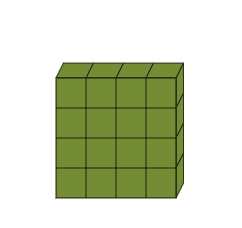
We start with concepts they already know like multiplication for area.

Help your child build lasting math fluency through active problem solving, right-level challenge, and clear weekly progress that prepares them for harder work ahead.
Early sessions do more than place your child at the right level. They show which core skills are solid, which ones are shaky, and which missing pieces are likely to cause trouble next.
That gives the tutor a clear first focus for grades 4-6. Instead of moving broadly through mixed review, Mobius can target the skills that will unlock better work in fractions, division, decimals, and multi-step problem solving.

You learn a lot of things in Mobius, so when they teach it to you in school, it is much easier.
Grades 4-6 are where math starts to build forward fast.
Fractions, decimals, multiplication, division, and multi-step problem solving become the base for ratios, pre-algebra thinking, and more independent work in later grades. Tutoring helps students strengthen those foundations before small gaps grow. In small-group tutoring, the tutor leads a shared live session while each student still works at the right level, with challenge and pacing adjusted inside the group.


Sessions keep students actively doing math, not just listening to explanations. They work through many questions live in short cycles, so they stay engaged and keep practicing how to start, think, and adjust.
When a student gets stuck, the tutor steps in right away with feedback that helps them recover and keep going. That steady solve, respond, and try-again rhythm builds stamina, attention, and better problem-solving habits over time.
Grades 4-6 should lead somewhere clear. As students get solid with fractions, decimals, multiplication, division, and multi-step reasoning, they are better prepared for ratios, pre-algebra ideas, and the faster pace that comes in grades 7-9. The platform advances students into harder work when readiness is established, and the tutor helps them stay confident and successful through each next step.

It is easier to support math growth when progress is visible. Instead of wondering whether tutoring is helping, parents can see that core skills are getting stronger and that old weak spots are becoming more secure.
That kind of clarity matters in grades 4-6, when stronger fundamentals open the door to harder work ahead. You can follow growth over time and make decisions based on real progress, not guesswork.

Grades 4-6 are where many important math ideas start working together instead of staying separate. Students strengthen multiplication and division, fractions and decimals, factors and primes, ratios, early algebra, measurement, geometry, and graphing and data. When those skills connect and hold, students can follow multi-step problems more calmly, make better decisions about what to do first, and handle school math with more independence.
Multiplication and Division Fluency
Students develop strong fluency multiplying and dividing multi-digit.
Fractions and Decimal Operations
Students compare, add, subtract, multiply, and divide fractions.
Factors, Multiples, and Prime Numbers
Students identify factors and multiples, recognize prime numbers,.
Ratios and Proportional Thinking
Students compare quantities using ratios and rates and.
Number Patterns and Early Algebraic Thinking
Students extend number patterns, describe rules, and express.
Students measure length, mass, volume, and time while.
Area and Geometry of 2D Shapes
Students calculate area and perimeter while exploring shape.
Graphing and Data Interpretation
Students organize data, read graphs, and interpret trends.
Featured Skill
Students develop strong fluency multiplying and dividing multi-digit.
Sample preview unavailable for this skill.

Progress works best when challenge keeps moving with the student. When a skill is solid, the platform advances into harder work. When understanding is still fragile, the tutor slows down, adds support, and helps the student strengthen the gap before moving on.
That keeps pacing ambitious without becoming overwhelming. Week to week, students are stretched when they are ready and supported when they need it, so growth feels steady instead of jumpy.
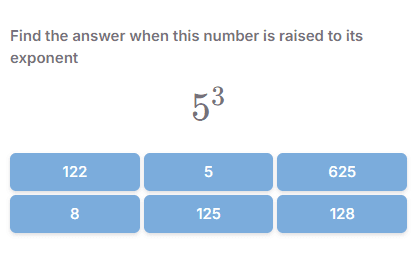
Scaffolding Example - Exponents
Start from repeated multiplication, then connect that to exponent notation and larger powers.
We start with concepts they already know like multiplication for area.
We will add more dimensions and larger numbers to push thinking.
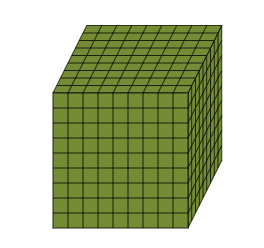
The abstract form fits the mental model they are already building.
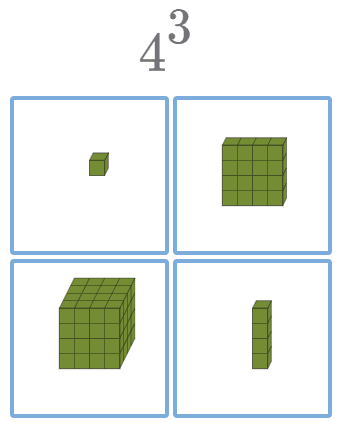
Approaching from multiplication again, the concept is clearer.
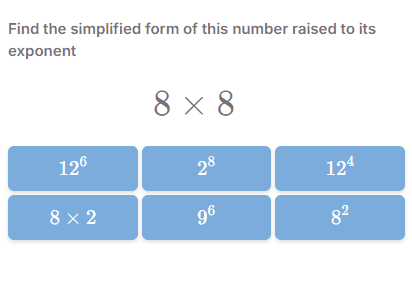
Now they have built their own understanding of exponent notation
Book a short evaluation call to talk through your child's current level, goals, and whether private math tutoring or a small group is the better fit. Small-group students can choose a recurring time for consistency, and families can still switch times whenever schedules change, even from week to week. If private math tutoring is the better fit, session times are worked out directly with the tutor for maximum flexibility. You'll leave with a clear recommendation and a practical next step.